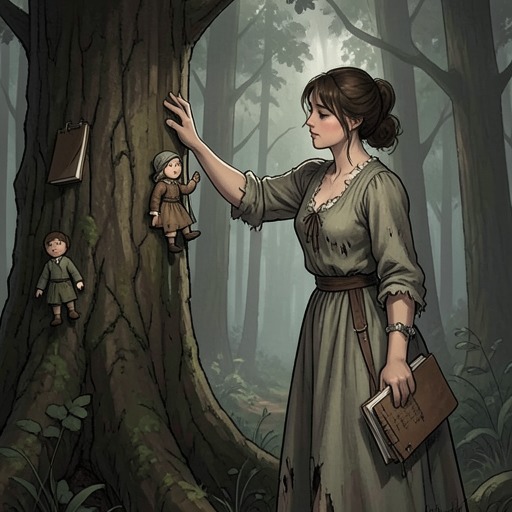
John Blackwood’s notebook
We Have Always Lived in the CastleJohn Blackwood’s notebook moves from a record of debts and expected favors into one of Mary Katherine Blackwood’s safeguards against intrusion. Its rusted nail and sudden fall make the object’s ordinary material weakness decisive: Mary interprets the failure as an omen, and later connects it to the limits of the protection she had expected books to provide when Charles Blackwood arrives.
Identity and Origin
The little notebook belonged to Mary Katherine Blackwood’s father, John Blackwood. It was not a diary or a family chronicle: it recorded the names of people who owed him money and of people he believed ought to do favors for him. Its contents therefore preserve a practical, transactional view of social relations, in which obligations could be listed and retained. The book’s former use contrasts with the protective purpose Mary gives it after her father’s death. Its change of function does not erase its origin; it carries an older family record into her private system of defenses.
The object is small enough to be wrapped and fixed to a tree, but Mary treats its placement as consequential. She wraps it thoroughly in heavy paper and nails it to a tree in the Woods surrounding the house. The careful covering and deliberate fastening make the notebook part of a constructed protection, rather than an item merely left outdoors. Its presence among Mary’s safeguards also joins the family’s history to the land around the house: a record associated with her father is made to serve the continuing security of his daughters’ home.
A Place in Mary’s Safeguards
Mary’s protection depends on repeated checking as well as on objects left in specific places. On Wednesday mornings she inspects the fence, repairs torn wire, and checks that the gates are locked. On Sundays she examines the safeguards she has set out, including buried silver dollars by the creek, a doll in the long field, and the notebook nailed to the tree. In this routine, the book is one element in a wider arrangement through which Mary tries to make the property secure. The notebook’s placement matters because it is checked as part of a system, not because the narrative establishes that it possesses independent power.
Mary connects the safeguards with things she has buried since childhood: pennies, ribbons, marbles, teeth, and colored stones. She imagines the land as holding these deposits in a protective web. The notebook differs from the buried objects because it is visible above ground and physically attached to a tree, but it participates in the same magical logic of placing an object and trusting its continued presence. Its role depends on remaining where Mary put it. When it is no longer securely fixed, the failure of the mechanism becomes an immediate threat to the sense of safety the ritual has supplied.
The Fall and the Omen
While returning from the creek, Mary finds that the notebook has fallen. She judges that the nail has rusted away and decides that the book is useless as protection. The cause she identifies is mundane decay, but the consequence she fears is not: because the safeguard has failed, she considers whether the book might now be actively harmful. She thinks of destroying it and replacing it with an item of her mother’s, such as a scarf or glove. The episode shows Mary responding to a changed object by revising its meaning and considering how to remove or replace it.
The timing lends the fall its ominous force. By the time Mary finds the notebook, Charles has probably already left his suitcase at the post office and is asking for directions to the house. Mary does not know this; she and Jonas are hungry and hurry back to the kitchen. The reader, however, can see that the object’s failure coincides with an approach Mary has not yet recognized. The notebook does not cause Charles’s arrival, and the evidence does not establish that its fall has supernatural force. Its narrative effect is to make Mary’s protective system appear vulnerable at the threshold of change.
Books, Charles, and the Limits of Protection
After Charles is in the house, Mary considers what might drive him away. She thinks of her mother’s jewels, but worries that they may not be powerful on a dull day and knows Constance Blackwood would object to taking them from their box. She also considers books, which she generally regards as strongly protective. The fallen notebook complicates that confidence: because her father’s book came down from its tree and did not prevent Charles from entering, Mary wonders whether books may be powerless against him. She does not declare all books useless; rather, one failed safeguard unsettles her willingness to rely on that category of object.
Mary’s response is to look for another device and set a condition on what she will do next: if Charles has not left within three days, she will break the hall mirror. This decision extends the notebook’s significance beyond the moment of its discovery. Its failure helps shape Mary’s assessment of the available protections, while the mirror becomes a contemplated alternative. The notebook remains an object in a sequence of choices, each governed by Mary’s belief that a safeguard must be correctly selected and used or it may fail to secure the house.
Narrative Significance
The notebook joins material detail to uncertainty. Its paper wrapping and rusted nail give the fall an intelligible physical cause; Mary’s interpretation turns that ordinary deterioration into an omen. The object thus marks the difference between what can be observed and what Mary believes the observation means. Her precautions are real actions—wrapping, nailing, inspecting—but their promised protection belongs to her magical understanding of the world. The book’s fall exposes the gap between careful ritual and reliable control.
It also brings two forms of family inheritance into contact. John Blackwood’s records preserve his judgments about debts and favors, while Mary repurposes the same object to defend the household he left behind. The notebook cannot keep Charles away, and its failure contributes to Mary’s suspicion that the familiar protection of books may not be enough. Its importance lies less in any demonstrated power than in the reversal it stages: a carefully placed safeguard becomes a sign that the house and its established routines are open to disruption.